
- Ferry route Split → Ancona / Pescara
- Crossing time ~10–11 hours overnight
- Distance (road) 230 km Split → Ancona ferry
- Best season May – October
- Recommended bike Forza 350 / Transalp 750
Why Split to Italy Is One of Europe's Great Motorcycle Journeys
The Adriatic crossing between Split and Italy is one of those travel experiences that people remember disproportionately to its duration. You are not crossing an ocean – the Adriatic at its widest point is less than 300 km across – but the overnight ferry journey creates a psychological break between two worlds that feels much greater than the geography suggests. You board in Croatia with the scent of the Mediterranean behind you, sleep in a cabin as the ship crosses open water in the dark, and wake to Italian coffee in the ferry cafeteria as the coast of Ancona or Pescara comes into view. It is an arrival, in the fullest sense of the word.
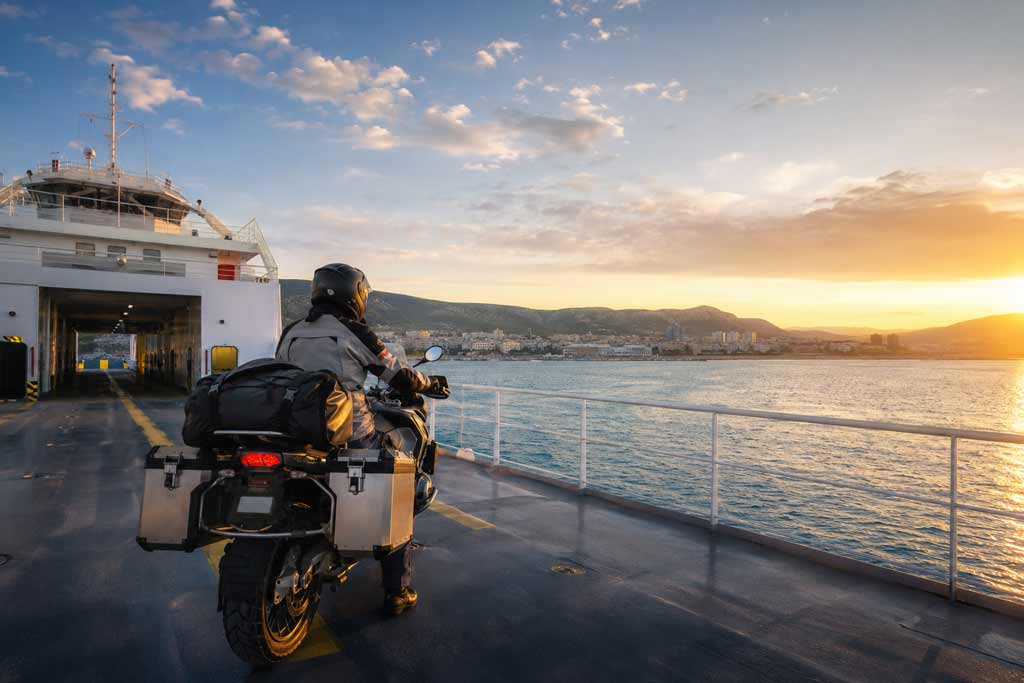
For motorcyclists, the crossing adds a dimension that car or bus passengers simply don't experience. The act of riding your motorcycle onto the ferry deck, securing it alongside other riders' machines from across Europe, and then riding off the ramp into Italy the following morning is a ritual that belongs specifically to two-wheeled travel. It is the kind of moment that makes you grateful you didn't just buy a plane ticket.
Ferry Routes: Split to Ancona and Split to Pescara
The two main ferry crossings from Split to Italy are operated primarily by Jadrolinija and SNAV (Grimaldi Lines). The Split–Ancona route is the more established of the two, with multiple departures per week throughout the season and daily sailings in peak summer. Crossing time is approximately 10–11 hours, typically departing Split in the early evening and arriving in Ancona the following morning. The Split–Pescara route offers a similar crossing time and is slightly further south, which suits riders planning to head into Abruzzo, the Apennines or further down the Italian peninsula.
Motorcycle pricing on both routes is significantly lower than car pricing – typically 30–50% less – and includes loading priority, which means motorcycles board first and disembark first. This advantage is worth more than it sounds: leaving the ferry ahead of the car traffic means you are on Italian roads in clear conditions before the queues form at the port exits. Book crossings well in advance for July and August sailings; they sell out early, particularly cabin allocations.
Preparing Your Motorcycle for the Crossing
The practical preparation for taking a rental motorcycle onto an Italian ferry is straightforward when renting from Moto Andro. We provide all documentation required for operating a Croatian-registered vehicle in Italy – the vehicle registration, proof of insurance covering Italy, and the rental agreement that confirms your right to take the vehicle across borders. EU citizens do not require any additional visa or border documentation for the Italy crossing.
On the ferry itself, the crew will direct you to the motorcycle parking area on the vehicle deck and will assist with securing the bike using the ship's lashing points. Switch off the fuel tap if your motorcycle has one, leave the bike in gear and engage the side stand. Your luggage comes with you to the cabin; do not leave valuables on the motorcycle. The crossing is generally smooth in summer, but rough weather is possible in spring and autumn – a cabin rather than a reclining seat is worth the cost for any overnight crossing.
Arriving in Ancona – Your First Italian Road
Ancona is a working port city in the Marche region, not a major tourist destination in its own right, but it is an excellent gateway to some of Italy's most rewarding motorcycle territory. From the port, the SS76 national road heads west into the Apennines, climbing through river valleys and limestone gorges that have an immediate visual drama after the flat coastal plain around the port. Within 30 minutes of leaving the ferry you are in mountain territory with very little traffic and roads that reward a motorcycle entirely.
The Marche region as a whole is one of Italy's best-kept secrets for motorcycle touring. The interior – the Sibillini mountains, the Furlo Gorge, the upper Metauro valley – offers riding that rivals Tuscany for scenery at a fraction of the tourist traffic. The coastal towns of Pesaro, Fano and Senigallia are attractive bases for an evening stop before heading inland the following day.
The Apennine Roads – Italy's Motorcycle Backbone
The Apennine mountain chain runs the length of Italy from Liguria in the north to Calabria in the south, and the roads that cross it – the old Roman consular roads, the regional SS routes, the local SP roads that connect villages – are among the finest motorcycle roads in Europe. Unlike the Alps, which attract enormous numbers of riders and can be crowded in peak season, the Apennines remain relatively undiscovered by international motorcycle tourists. The roads are good, the scenery is spectacular and the culture – the food, the towns, the pace of life – is distinctly and authentically Italian.
From Ancona heading south, the route through the Gran Sasso massif in Abruzzo – Italy's highest mountain outside the Alps, reaching 2,912 metres – offers roads of genuine drama and beauty. The road through the Campo Imperatore plateau, a high-altitude plain sometimes called 'Little Tibet', is an extraordinary piece of Italian geography that virtually no international visitor ever sees. On a motorcycle in September with clear skies and empty roads, it is exceptional.
Arriving in Pescara – the Southern Route
If you take the Split–Pescara crossing instead of the Ancona route, you arrive on the Abruzzo coast with the Gran Sasso immediately to the west and Rome approximately 200 km to the southwest. This route suits riders whose Italian itinerary includes Rome, the Lazio region, or who plan to continue south toward Naples and the Amalfi coast.
The road from Pescara into the Gran Sasso via L'Aquila is one of the most dramatic approaches to an Italian mountain region that exists. L'Aquila itself – the regional capital of Abruzzo, still rebuilding after the 2009 earthquake – is a city of considerable character and historical significance, and the surrounding mountain landscape is genuinely spectacular in any season.
Combining Croatia and Italy – The Ideal Itinerary
The classic two-week itinerary that combines Croatia and Italy for a motorcycle tourist starts in Split. Days one to four cover the Croatian coast south to Dubrovnik, with detours into Bosnia and Montenegro. Day five returns to Split for the evening ferry to Ancona. Days six to thirteen explore the Italian Apennines, Tuscany, Umbria or the Amalfi coast depending on preference. Day fourteen takes a direct flight home from Rome, Naples or Florence, leaving the motorcycle at a pre-arranged handover point.
For guests renting from Moto Andro who want to leave the motorcycle in Italy rather than return it to Split, we can arrange one-way rental with drop-off at agreed locations in Italy. Contact us to discuss the options – this is a service we have provided for several guests combining multi-country itineraries, and the logistics are straightforward with sufficient planning.
Practical Information for the Split–Italy Route
Fuel in Italy is available everywhere but is more expensive than in Croatia – currently among the highest fuel prices in Europe. Italian motorways (autostrade) require tolls payable by cash or credit card at toll booths. Speed limits are 50 km/h in urban areas, 90 km/h on regional roads, 110 km/h on dual carriageways and 130 km/h on motorways. Italian traffic police (Polizia Stradale) are active on the main corridors and enforcement is taken seriously.
Italian road surfaces vary considerably by region – the north and centre are generally excellent, while some southern roads can be rougher. ZTL zones (Zona a Traffico Limitato) in historic city centres restrict access during certain hours and cameras enforce the rules automatically. Motorcycles are generally permitted where cars are not in ZTL zones, but check the specific rules for each city. The Moto Andro team can advise on all of these practicalities before your departure from Split.
Route Options at a Glance
- Route A – Ancona
Best for: Marche, Umbria, Tuscany, northern Italy. Departs Split ~20:00, arrives Ancona ~07:00. - Route B – Pescara
Best for: Abruzzo, Rome, Amalfi coast, southern Italy. Similar crossing time. - Operators
Jadrolinija, SNAV (Grimaldi Lines). Book direct or through ferry booking platforms. - Motorcycle fare
Approx. 30–50% less than a car. Cabin recommended for overnight – book in advance. - Documents needed
Vehicle registration, insurance (Green Card), rental agreement, passport or EU ID. - Moto Andro provides
All cross-border documentation included in rental. One-way drop-off in Italy available on request.
Book Your Ride in Split
Brand new motorcycles and scooters. Fast delivery. Expert advice from local riders.
Browse rental vehicles